


Aleran FAQs: ERP-connected B2B commerce built for manufacturers
Aleran is a digital sales platform built from the ground up for industrial manufacturers. Get answers about CPQ, customer portals, ERP integration, quoting, ordering, and how Aleran helps manufacturers sell digitally across every channel.
General Questions About the Platform
1. What is Aleran Connected Commerce?
Quite simply, Aleran is an all-in-one AI powered, ERP-connected quoting and sales platform built for mid-sized B2B manufacturers to simplify and scale digital selling.
Aleran Connected Commerce is built for B2B manufacturers with complex products, sales processes and pricing. It unifies quoting, CPQ, customer portals, eCommerce, and order management into a single front-office experience – without replacing your ERP.
Our enterprise-grade, cloud-based platform is designed to work seamlessly out-of-the-box (or as a headless integration) with your ERP, CRM and any other critical business software via our custom integration services and robust library of APIs.
2. Who does Aleran serve? What kind of companies can use Aleran?
Aleran is purpose-built for mid-sized manufacturers ($20M–$1B in annual revenue) that sell configurable, engineer-to-order, or complex products and struggle with slow quoting, manual sales processes, or disconnected customer experiences.
Common industries include:
- Industrial equipment & machinery
- Electrical components
- Valves, pumps, and fluid handling
- HVAC & building systems
- OEM components and aftermarket parts
3. What are some of Aleran’s product features?
The Aleran platform helps manufacturers digitally transform sales and gain operational efficiency with no additional tech investments, hidden costs or in-house builds. Some key features include:
- End-to-end sales order management (SOM)
Automate admin tasks and streamline order management with native, self-service quoting and ordering. - Configure, price, quote (CPQ)
Generate quotes for configurable products and then convert to sales orders quickly and accurately. - Catalog-embedded buying
Transform PDF catalogs, brochures, line cards and more into dynamic, digital and secure eCommerce sites. - Product inventory management (PIM) for B2B Sales
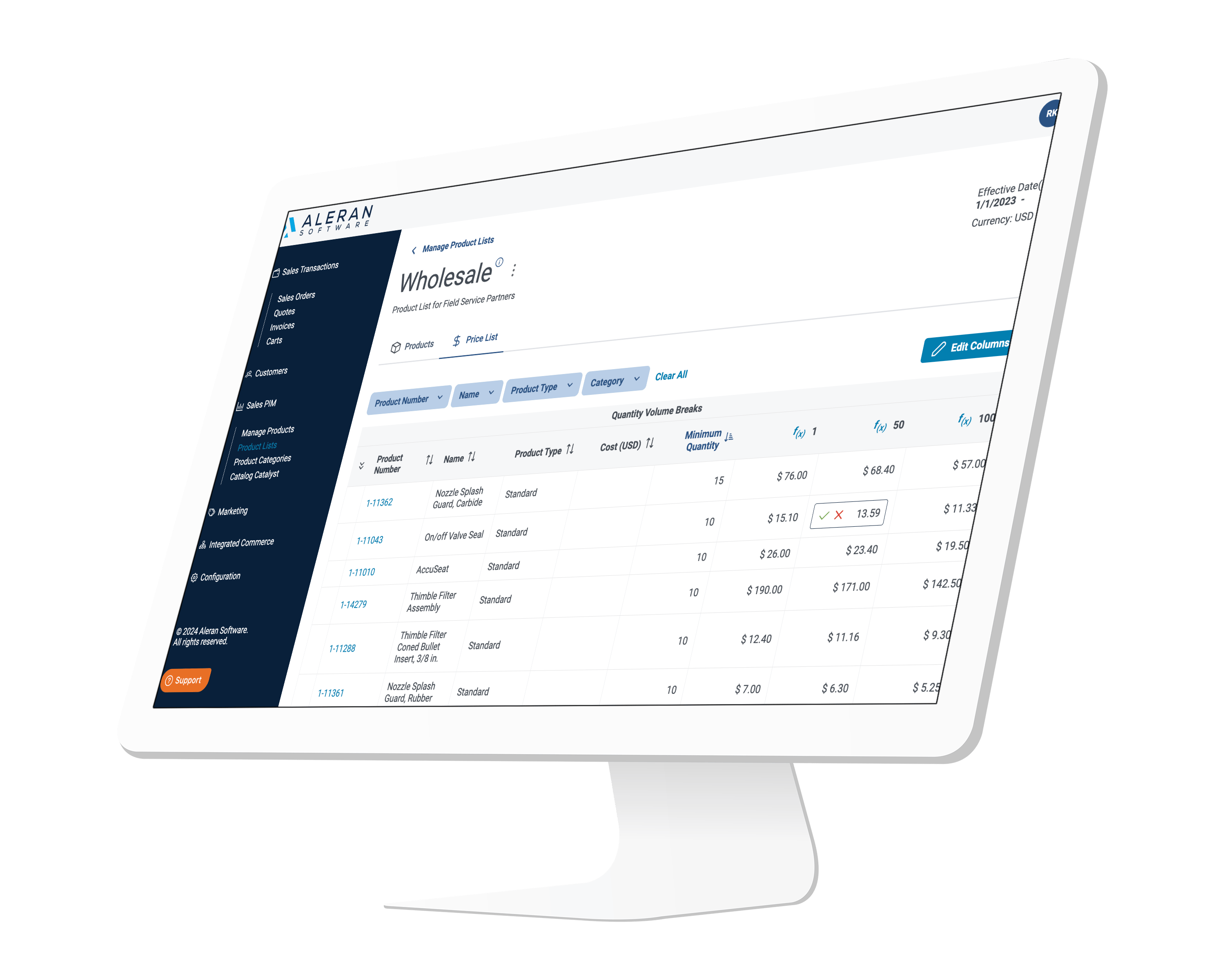
Review, manage and store product info, assets and pricing data in one place, keep track of product availability and sort by segment, channel, geography and customer. - Customer portals
Log-in for personalized content according to user role and need, reduce call center costs, and increase loyalty and conversions. - Multi-storefronts
Create and manage multiple digital commerce experiences, including eCommerce sites, shoppable PDF catalogs, and more, all managed through a single back end.
4. Can I use Aleran even if I don’t have a product catalog because I am a “job shop” or an engineer-to-order or made-to-order manufacturer?
Yes! Aleran is flexible enough to work for manufacturers who don’t use catalogs because of their highly customized processes.
For example, ETO manufacturers are able to streamline and modernize their sales and eCommerce processes by using Aleran’s CPQ (configure, price, quote) feature, which allows them to generate quotes for configurable products and then convert to sales orders quickly and accurately. In addition, ETO manufacturers can gain huge efficiencies from implementing self-service order management, one-click reorders, and OEM- or customer-specific portals.
5. What tools and features should manufacturers look for in an eCommerce platform?
When evaluating B2B eCommerce platforms, there are an assortment of key features to look out for, including:
- Personalized experiences and promotions
- Easy online quoting and ordering
- Accurate pricing and terms for each B2B customer
- Shoppable PDF catalogs
- Self-service customer portal (look-up orders, reorder, see status updates, manage contacts)
- Secure online payments
6. How does Aleran integrate with ERP systems?
With minimal IT and no customization, Aleran integrates directly with leading ERPs using secure APIs and pre-built connectors. It acts as a front-office layer to extend the manufacturing ERP investment – not a replacement.
While Aleran is ERP agnostic, it does commonly see integration needs for the following:
- SAP certified, available on the SAP Store”
- Epicor (Kinetic and legacy versions)
- Infor SyteLine / CloudSuite Industrial
- Sage
- Aptean
- SYSPRO
- Acumatica
With Aleran, the ERP remains the system of record for pricing, inventory, customers, and orders to run operations. Aleran becomes the sales engine built to run revenue.
7. Is Aleran just a CPQ (Configure Price Quote) tool?
It can be used just for CPQ, but it is also so much more than that to service the entire manufacturing customer journey – including AI-Guided Selling, a Sales PIM, Self-Service Portals, and eCommerce.
Aleran’s CPQ includes advanced native CPQ capabilities for configurable and complex products.
Unlike traditional Engineering-focused CPQs, Aleran’s CPQ is Sales and Customer friendly – easy to use. Think of it as the front layer – smart enough through ERP-connection and AI that goes to the BOM level – to get faster more accurate quotes at the start of the process.
It goes beyond traditional CPQ by connecting configuration and pricing directly to:
- Customer portals
- eCommerce
- Dealer and distributor workflows
- ERP order processing
- AI-guided selling experiences
8. Is Aleran a manufacturing ecommerce solution? Your Title Goes Here
It is but also so much more to support the complete manufacturing customer journey.
Aleran is unique in that not only is it designed for mid-sized B2B manufacturers with limited IT who need results and ROI fast, but it has native CPQ and eCommerce and more for a fully connected multichannel sales experience that fundamentally shifts how manufacturers look at modernizing their go-to-market.
9. How does Aleran support manufactures' B2B eCommerce needs?
Aleran supports true B2B eCommerce, for manufacturers in multiple ways including:
- Account-specific pricing
- Configurable products
- Quote-to-order workflows
- Approval rules
- Contract pricing
- ERP-connected inventory and order processing
It’s designed for b2b manufacturers with complexity – not generic retail use cases.
10. How does Aleran use AI?
Aleran applies AI where it creates real business value for manufacturers without adding complexity, including:
- Faster, more accurate quoting
- Suggestive selling and product recommendations
- Guided selling experiences
- Reduced manual approvals
- Improved searchability for products and configurations
Aleran’s AI philosphy is designed to assist sales and customers to make the experience faster and more seamless – not to replace people or human-centered expertise.
11. Can customers and dealers self-serve with Aleran?
Yes. Aleran enables secure self-service portals for:
- Customers
- Dealers
- Distributors
- Sales reps
Users can:
- Build and request quotes
- Reorder products
- View pricing and order history
- Track orders and invoices
- Reduce email and phone-based requests
12. How is Aleran different from building inside the ERP?
Many manufacturers try to solve front-office challenges by customizing their ERP. This often leads to:
- Technical debt
- Slower upgrades
- Higher IT support burden
Aleran decouples front-office complexity while staying tightly integrated to ERP giving IT control without over-customization.
13. Is Aleran secure?
Yes. Aleran’s security is built on Azure, a cloud platform managed by Microsoft, which has a 99.99% uptime.
Aleran follows enterprise-grade security and compliance best practices, including:
- Secure API integrations
- Role-based access controls
- Data governance aligned with ERP ownership
Security and governance are designed with IT teams in mind. While it isn’t currently SOC 2-certified, its status as of April 2026 is pending.
14. What compliance does Aleran offer?
Aleran has enterprise-grade security, including role-based controls, secure APIs, and more.
It also has Tier-1 cloud infrastructure (Azure) and support for industry requirements, including CMMC, etc.
15. How does Aleran support manufacturing growth without adding complexity?
Aleran helps manufacturers scale by:
- Making products easier to sell
- Automating repeatable sales work
- Supporting multiple channels (sales reps, customers, dealers)
- Keeping ERP clean and governed
It’s designed to grow with you – all of the benefits of enterprise-level sophistication but without the drag and price tag.
16. Is Aleran Avalara certified? How do Aleran and Avalara work together?
Aleran is a technology partner with an Avalara certified integration.
This means that you can have peace of mind transactions via Connected Commerce are fully compliant with Avalara’s products.
ERP Integration FAQs
1. Does Aleran integrate with Epicor?
Aleran’s hub-and-spoke architecture can connect a single Aleran instance to multiple Epicor
environments — different versions, different databases, or multiple companies within a single Epicor
instance. A NYSE-listed industrial manufacturer with 60+ independently operated companies on Epicor
selected Aleran as their corporate standard for quoting, portals, and ordering across the portfolio.
2. Does Aleran integrate with Infor CloudSuite Industrial / SyteLine?
and customer information. Aleran provides CPQ, customer self-service portals, distributor ordering, and
sales order management that syncs with SyteLine automatically. Business teams manage the platform
day-to-day without IT dependency.
3. Does Aleran integrate with SAP?
S/4HANA Cloud ERP (formerly GROW with SAP), SAP S/4HANA Cloud ERP Private Edition (formerly
RISE with SAP), and SAP ECC. A global industrial manufacturer on SAP uses Aleran for configured
quoting and self-service ordering across their electrical connectors division, with expansion into their
robotics division.
4. How is Aleran different from Epicor CPQ or Infor CPQ?
Aleran and ERP-native CPQ tools are complementary. ERP CPQ engines handle internal product
configuration. Aleran handles everything around CPQ: the customer-facing portals, distributor self-
service, B2B ordering, sales order management, and multi-channel commerce. For customers that have
Epicor or Infor CPQ, Aleran extends that configuration to external audiences through portals and self-
service. For customers that don’t need full CPQ power, Aleran provides its own configure-to-order engine
alongside commerce and portal capabilities in one platform.
5. How is Aleran different from SAP Commerce Cloud?
serves mid-market discrete manufacturers who need CPQ, portals, and ordering without the cost and
implementation complexity of Commerce Cloud. Aleran is SAP certified and available on the SAP Store
with validated integrations for S/4HANA Cloud ERP, S/4HANA Cloud ERP Private Edition, and SAP ECC.
FAQ PAGE UPDATE INSTRUCTIONS — FOR CHETAN
Page 5
It is purpose-built for industrial manufacturing workflows and can be deployed in weeks rather than
months.
6. Can Aleran connect to multiple ERP instances at the same time?
environments simultaneously. This means a holding company with divisions running different ERP
versions, different databases, or even different ERP vendors can standardize their digital sales layer
without forcing ERP consolidation. Each division retains its own pricing rules, product catalogs, and
workflows.
Technology & Architecture
1. What is Aleran’s hub-and-spoke architecture?
ERP systems simultaneously. A holding company with divisions running different ERP versions or
different ERP vendors can standardize their digital sales layer without forcing ERP consolidation. Each
division retains its own pricing rules, product catalogs, and ERP workflows while corporate IT governs one
shared platform. This architecture is unique in the mid-market manufacturing software space.
2. Can business teams manage Aleran without developers?
channels, update product catalogs, modify pricing rules, configure portals, onboard new divisions, and
launch storefronts without writing code or filing IT tickets. This no-code administration model significantly
reduces total cost of ownership.
3. Does Aleran use AI?
recommendations, and content generation. AI helps end customers find the right products even without
knowing exact part numbers, reduces training time for new portal users, and helps sales reps identify
cross-sell and upsell opportunities. AI capabilities are native to the platform, not bolt-on integrations.
Pricing & Implementation
1. How much does Aleran cost?
Aleran is affordably priced – no cost per user or revenue sharing. Cost can be monthly or annually and includes all of the Aleran features and integrations, including Avalara, ERP and more.
Our flexible pricing and plans were designed to work for growing businesses. Contact us today to get an estimate.
2. How do you deal with variable freight quotes for credit card orders?
Aleran allows buyers to enter credit card information for preliminary authorization. We don’t store the number, instead, we tokenize it for security purposes and then pass it through the ERP for processing once the order (with final shipping costs) is ready to ship. Because it’s not possible to charge a higher amount than was originally authorized, a placeholder “full retail freight” estimate can be added at the time of authorization. Alternatively, a separate invoice can be sent just for freight costs.
3. How long does it take to go live?
Aleran prides itself on its speed to implementation, typically getting customers up and running in less than 90 days. Time-to-launch will be impacted by individual project scope and complexity. Contact us today to get a free time and cost estimate.
4. How do you integrate with iPaaS solutions?
Aleran works with multiple iPaaS (Integration Platform as a Service) solutions for syncing data with ERPs and other business applications (like CRM, WMS and EDI tools). These tools expose the core data elements in each system, and then our professional services team creates templates to map the necessary data elements based on each customer’s specific business needs (e.g. 1-way vs. 2-way sync on products; frequency of pricing sync, and so on). Contact us today for more details on our integrations.
5. Do I need a dedicated sales staff to benefit from using Aleran?
Though the Aleran platform has clear benefits when used by B2B sales teams, it can also help organizations without a dedicated sales staff.
Aleran can help companies implement automated quoting, self-service order management, one-click reorders, catalog-embedded buying experiences, and OEM or customer-specific portals – all without the help of a dedicated sales team.
Bottom line: Aleran helps make all your teams more efficient, keeping their processes moving (even outside regular business hours) and streamlining the buyer experience.
6. Is Aleran Connected Commerce an IT intensive commerce platform for manufacturers?
No, in fact Aleran Connected Commerce is specifically designed for mid-sized manufacturers with resource constrained teams so they can quote, sell and service online with ease – quickly and affordable. Aleran delivers all of the enterprise-grade technology, experience and security but none of price tag or time drag. Aleran requires minimal IT to go live and is easily managed by Sales and Marketing day to day.
7. What support can I expect from Aleran?
Aleran delivers end-to-end white glove treatment. Each customer gets a dedicated project and account manager as well as technical lead to partner closely from IT to Sales to Finance – more.
Aleran also has a deep network of partners across ERPs to help consult, strategize design and implement to ensure maximum ROI fast.
Benefits of Aleran & Determining Fit
1. What are some of the advantages of Aleran’s digital commerce platform?
Key benefits of Aleran’s B2B commerce platform for manufacturers:
- Is built solely for manufacturers, with the out-of-the-box ready features and functionality they need most
- Provides flexible, transparent pricing and plans, including hand-on support
- Deploys quickly and easily, with minimal IT lift
- Supports all digital commerce and offline sales channels
- Includes built-in sales order management and product inventory management for seamless integration with the commerce platform
- Digitizes and automates manual processes, workflows and tasks
- Offers hundreds of pre-built integrations for your digital channels, non-digital channels and core business systems
2. How can creating a strong digital quoting, selling and customer experience benefit manufacturers to achieve growth goals?
A strong digital quoting, sales and customer experience for manufactures is a necessity – no longer nice to have.
In our Built to Sell report surving 200 U.S.-based mid-sized B2B manufacturers, 86% reported losing a deal from slow manual quoting. The cost? Up to 15% in revenue leakage each year.
In addition to solving for the revenue leakage from slow and manual quoting, some of the benefits include:
- Better market reach: find a broader audience and connect with potential customers wherever they are
- Enhanced customer experience: digital, self-service tools enable a more streamlined and efficient B2B customer experience
- Increased sales opportunities from better search visibility and discovery: capitalize on built-in SEO and AI-search optimization for product content to be discovered when your buyers are looking. Generate per revenue per sale by automated upselling and cross-selling through personalized recommendations and showcase a wider range of products or services
- New operational efficiencies: automate many aspects of the sales process, from order processing to inventory management and free up staff for more high-value tasks
- Data-driven insights: access valuable data about customer behavior, preferences, and buying patterns to guide your marketing strategies, product development and business decisions
- Improved customer relationships: maintain continuous engagement with your clients via promotional marketing efforts and personalized content
- Competitive edge: differentiate your business from competitors who may not have as strong an online footprint
- Scalability: grow your business by adding new products, services, and enter new markets at a lower cost
- Agility: update your offerings, adjust pricing on the fly to meet tariff or regulatory or market shifts, or launch marketing campaigns in reaction to industry trends or customer feedback
3. How do we know if Aleran is the right fit for us?
Aleran is a strong fit if:
- Quoting is slow or manual
- You have high order volume, high SKUs, and complex configuration
- Sales relies on spreadsheets or email
- Systems are disconnected – or there are multiple disconnected systems
- Have a complex go-to-market with disparate systems and diverse channels, products, pricing and processes
- Need to centralize, comply and extend your ERP
- ERP customization or maintenance is becoming a risk
A short conversation can quickly determine fit.
4. How can manufacturers battle “fear of the unknown” among their teams when considering B2B Commerce?
Occasionally team members may be overwhelmed or intimidated by technical language and the prospect of introducing new protocols. One of our founding principles at Aleran is to reduce the fear of technology, so we made it our mission to design a platform that is smart (streamlining and automating the sales back office), simple (easy to learn and use), and supported (video tutorials, same day onboarding, and customer support staff ready to make the transition as painless as possible).
But the very best way to convince a reluctant office manager to consider a new solution is to take our software for a test drive — we encourage prospective customers to sign-up for a free demo of our platform.
Contact us today to get started.