


Why manufacturers lose orders they should win
Your buyers changed five years ago. Your sales process didn’t. Here’s what’s actually happening — and what the manufacturers gaining share are doing differently.
Something shifted in the last five years, and if you sell complex, configurable products, you’ve probably felt it. The people on the other side of your sales process aren’t the same people who were there five years ago.
During COVID, a wave of experienced lead buyers took early retirement. They were comfortable with spreadsheet quotes, phone calls, and the slow back-and-forth of traditional quoting. That world isn’t disappearing entirely, but it’s shrinking fast. The people replacing them grew up researching, comparing, and purchasing at their own pace — and if you can’t offer that, they’ll find someone who can.
That should give every commercial leader pause. You’re not losing on product quality or price. You’re losing on process. The three-month turnaround for what should be a fast reorder. The emailed quote that sits in a queue. The customer who could return a quote faster — easily — even when they weren’t getting the lowest price.
The single biggest factor? Speed. The manufacturer who could return a quote faster usually won — even when they weren’t offering the lowest price.
The manufacturers gaining share aren’t the ones with the best products. They’re the ones whose customers can configure, price, and order without calling anyone.
The cost of standing still
The most common objection sounds like this: “Our products are too complex.” And fair enough. One industrial pump manufacturer has roughly ten thousand product lines, up to sixteen possible configurations each, and they haven’t even scratched the surface of making that self-service.
But that complexity already lives in your data. Your configuration rules, engineering constraints, regulatory exclusions — it’s all recorded somewhere. The question isn’t whether the knowledge exists. It’s whether you’re making it accessible.
This is where things get uncomfortable. The ERP portal your company stood up three years ago? It was a genuine investment. But most ERP portals were designed for inventory lookups and order status checks, not for the kind of guided, configured buying that complex manufacturers actually need. If a customer can’t figure out which configuration of your product they need without calling someone, the portal isn’t doing its job.
Complexity is real — but it’s not the barrier you think
This is where an honest distinction matters. The manufacturers who’ve adopted AI-guided configuration aren’t eliminating their sales teams — they’re freeing salespeople from the transactional work of re-entering quotes, checking configurations, and fielding routine status calls — so they can focus on the consultative selling that actually closes business.
After-sales is the same story. Inside sales and customer service teams get buried under administrative volume: “where’s my order,” “what’s the price of,” “resend the invoice, please.” When customers can pull that information from a portal without generating a ticket, your team gets time back for conversations that move the needle. And there’s a secondary benefit that’s easy to overlook: when you let customers configure on their own terms — even if they end up calling you to confirm — the quality of that initial conversation is dramatically better.
Five signs your sales process is costing you orders
Your reorder rate is dropping but your customer satisfaction scores aren’t
Customers like your product. They just found someone easier to buy from. This is the most dangerous signal because it doesn’t show up in your NPS — it shows up six months later in your revenue.
Your average quote turnaround is measured in days, not hours
For standard configurations, a quote should be instant. For complex ones, same-day. If your sales team is manually assembling quotes from spreadsheets and price lists, you’re losing deals to whoever responds first.
Your dealers call your inside sales team to place orders
This is a portal problem. If your channel partners would rather pick up the phone than use your ordering system, the system isn’t working. Every one of those calls is a cost you shouldn’t be carrying.
Configuration errors make it through to production
When configuration is manual, errors are inevitable. If a customer orders it, their intent was good, but if they built it from a PDF and guessed at specs, the resulting rework costs you margin and trust.
Your best salespeople spend more time on admin than selling
If your top reps are re-keying orders, chasing approvals, and emailing revised quotes, you’re paying senior sales rates for data entry work. The math doesn’t hold.
Starting where the risk is lowest
Nobody has to bet the business on a full transformation overnight. The smartest manufacturers getting real results started with an aftermarket parts catalog — lower risk, high frequency, and the payoff is immediate. If running a quote currently takes a day or two, making that near-instant for your standard products is measurable in weeks, not months.
From there, the path extends naturally: portal for reorders first, then guided configuration for new business, with self-service quote-to-order for the configurations that don’t need engineering review. The goal isn’t to remove oversight. It’s to remove friction. And critically, none of this needs to obsolete what’s already working. Your CRM stays. Your ERP remains the system of record. The commerce layer sits on top and between — connecting the customer-facing experience to the back-office systems you’ve already invested in, rather than replacing them.
Curious what this looks like with your numbers? Aleran’s ROI calculator lets you plug in your own order volumes, quote turnaround times, and average deal sizes to see the impact of moving even a fraction of your sales process online.
The competitive window is open
Manufacturers who move early are seeing real results — typically around three months to ROI from go-live. Average order values often go up, not because customers spend more, but because they order more frequently in smaller batches now that the process is fast enough. And many segments — mid-market industrial manufacturers specifically — are still early enough that offering digital self-service is uncommon enough to be a genuine differentiator.
The buyers across from you today aren’t going to revert to phone-and-email quoting. They’ll buy from whoever makes it easiest. The question isn’t whether to adapt, but how quickly.
What changes when you get this right
Days to hours. Hours to instant.
Guided configuration with rules-based pricing means standard quotes happen without human intervention. Complex quotes get a head start.
Self-service, not phone calls
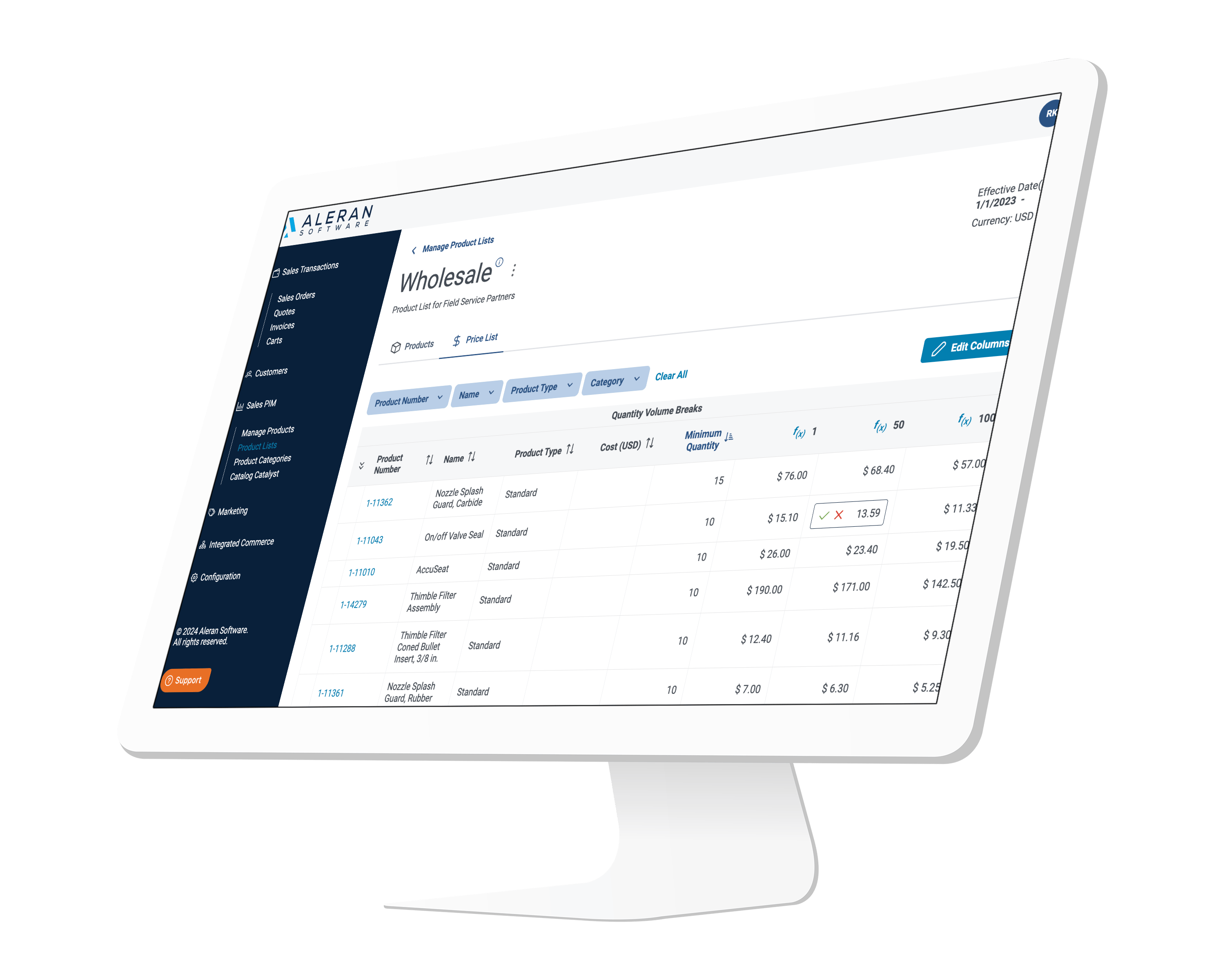
Customers and dealers reorder from their history with customer-specific pricing applied automatically. Your inside sales team stops being an order desk.
Caught before production, not after
Configuration logic enforces valid combinations at the point of order. Engineering review focuses on genuinely complex requests, not catching spec mistakes.
Selling, not processing
When transactional orders handle themselves, your reps spend their time on new business, complex deals, and relationship building.
See what this looks like for your business
Aleran Connected Commerce sits on top of your existing ERP and CRM — no rip and replace. Most manufacturers are live in weeks, not months, and see ROI within the first quarter.