


At some point, almost every manufacturers reaches the same conclusion.
“We need a portal.”
Customers want to check order status.
Sales wants fewer emails and manual reorders.
IT wants control, security, and ERP integrity.
So the idea surfaces—often quietly at first:
“What if we just build one ourselves?”
On paper, it sounds reasonable. You know your products. You know your ERP. You already have developers.
In practice, building your own self-service portal for manufacturing customers is one of the most expensive, slow, and risky paths you can take.
Here’s why.
1. Manufacturing portals are far more complex than they look
A “simple” portal request usually starts with:
-
Order history
-
Reordering
-
Quote requests
But manufacturing reality quickly complicates things:
-
Configuration rules tied to engineering logic
-
Customer-specific pricing and contracts
-
ERP-driven availability, lead times, and substitutions
-
Revision control, BOM accuracy, and approvals
-
Aftermarket part compatibility
-
Multi-ERP or legacy ERP environments
What looks like a UI project becomes a business-critical system touching pricing, margin, fulfillment, and customer experience.
That complexity doesn’t show up in sprint planning—but it shows up later in support tickets, workarounds, and revenue leakage.
2. ERP integration is where most internal portals fail
ERPs were never designed to power customer-facing experiences.
When you build your own portal, you’re forced to:
-
Expose ERP logic externally (often unsafely)
-
Create brittle point-to-point integrations
-
Rebuild pricing, configuration, and validation logic outside the ERP
-
Maintain custom code every time the ERP changes
The result is usually one of two outcomes:
1. The portal stays shallow and customers still email Sales
2. Neither delivers the ROI that justified the build in the first place.
3. You inherit permanent maintenance and security risk
A custom portal is never “done.”
Every year, you’ll need to:
-
Patch security vulnerabilities
-
Update authentication and access controls
-
Maintain SOC 2, audit, and compliance evidence
-
Refactor integrations as systems evolve
-
Support new devices, browsers, and user expectations
That responsibility doesn’t go away—it compounds.
And when security teams get involved (as they should), internal portals often struggle to meet modern standards without major rework.
4. Internal builds pull IT away from what actually drives growth
Every hour your team spends building and maintaining a portal is an hour not spent on:
-
ERP optimization
-
Analytics and forecasting
-
Automation inside operations
-
Infrastructure, data, and security strategy
Manufacturers rarely regret modernizing how they sell.
They often regret how much internal capacity it consumed to get there.
5. Customer expectations move faster than internal roadmaps
Your customers don’t compare your portal to other manufacturers.
They compare it to:
-
Amazon
-
B2B distributors
-
Modern industrial suppliers
-
Visual, guided buying experiences
That means expectations for:
-
Speed
-
Clarity
-
Self-service configuration
-
Visual confirmation
-
Mobile access
Internal portals tend to freeze in time—built for yesterday’s needs, not tomorrow’s buyers.
6. The hidden cost: opportunity loss
This is the part most teams miss.
While you’re:
-
Scoping
-
Building
-
Debugging
-
Rebuilding
Your competitors are:
-
Quoting faster
-
Capturing aftermarket reorders
-
Reducing sales friction
-
Expanding accounts without adding headcount
The biggest cost of a DIY portal isn’t development—it’s missed revenue.
A better approach: extend, don’t reinvent
The manufacturers seeing the most success today are not ripping and replacing their ERP—or building portals from scratch.
They are:
-
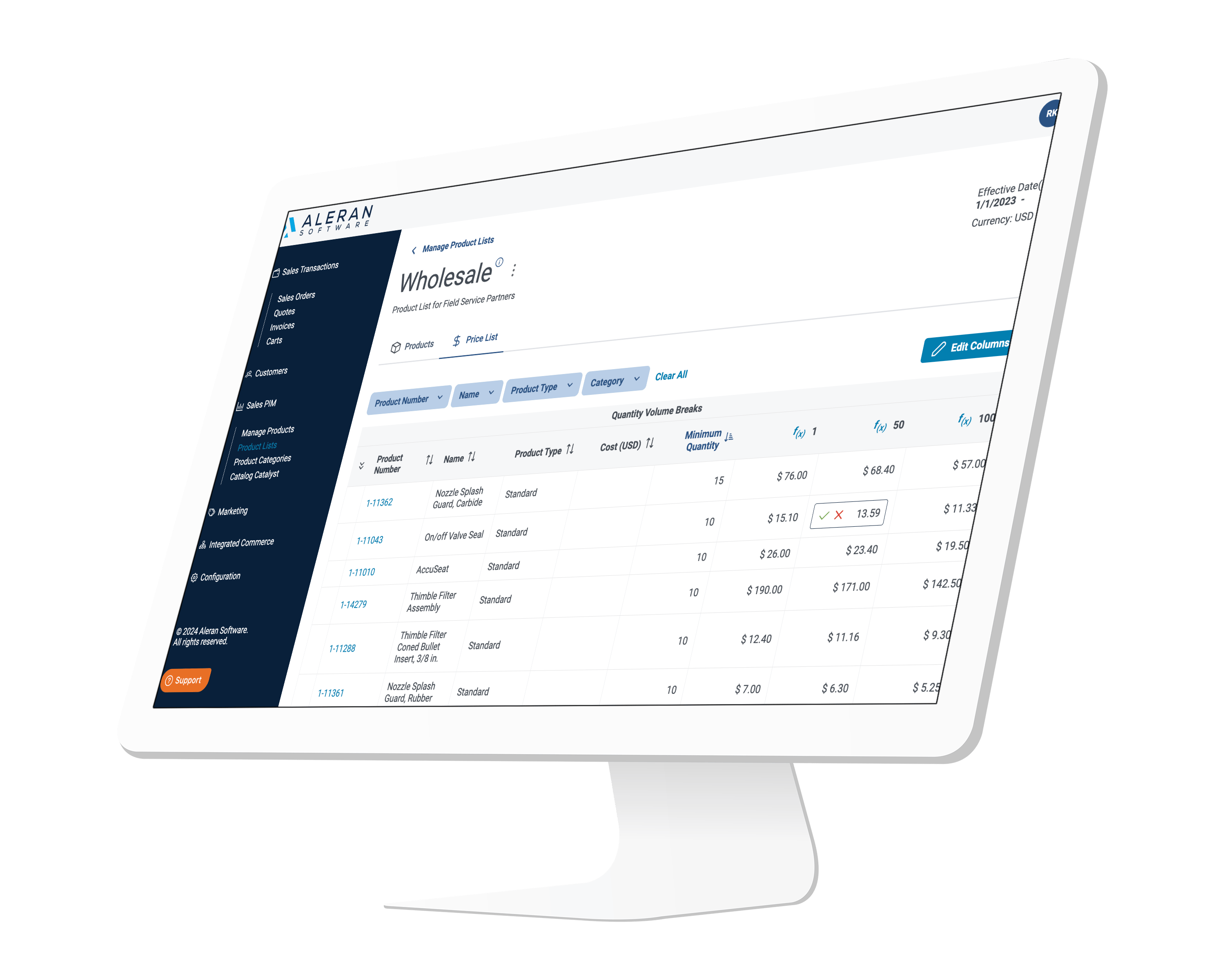
Extending ERP data safely to customers
-
Enabling self-service without exposing ERP complexity
-
Supporting quoting, reordering, and configuration in one experience
-
Adding visual and guided buying where it matters
-
Launching in weeks, not years
Most importantly, they’re doing it without turning IT into a product company.
Final thought
Building your own customer portal feels like control.
In reality, it often becomes a long-term liability—one that’s hard to unwind once customers and internal teams depend on it.
Modern manufacturing selling doesn’t require more custom code.
It requires the right layer between your ERP and your customers.
If your goal is faster quoting, happier customers, and scalable growth—there’s a better way than building it all yourself.
Let’s Talk
If you are reassessing how you sell, including quoting – or have questions to help assess your requirements, please send me a message at sales@aleran.com.
