


Ask a sales rep at a mid-sized manufacturer what they think of their CPQ system, and you’ll likely hear one of three answers: they barely use it, they’ve built workarounds around it, or they’re still waiting for it to go live.
That’s not a coincidence. It’s a pattern — and it points to a fundamental mismatch between how most CPQ software is designed and how manufacturing sales actually works.
The promise of CPQ (Configure, Price, Quote) is straightforward: help sales teams produce accurate, fast, professional quotes for complex products without relying on tribal knowledge, back-and-forth with engineering, or error-prone spreadsheets. For manufacturers with configurable products, multi-tier pricing, and distributed dealer and distributor networks, that promise is genuinely compelling.
The problem is the execution. Most CPQ platforms were built for either enterprise software companies managing subscription tiers or for engineering teams managing deep product logic. Neither of those is a manufacturing sales team trying to respond to a dealer quote request before the end of the day.
Here’s why most CPQ is too complex for manufacturing sales — and what the right approach actually looks like.
The CPQ Complexity Problem in Manufacturing
Built for Engineers, Not Sellers
The most common complaint manufacturers have about traditional CPQ isn’t that it lacks features. It’s that it has too many of the wrong ones. Enterprise CPQ platforms — the Salesforce CPQs, the Conga CPQs, the heavyweight configurators — are architected to handle deep engineering rules: CAD integrations, tolerance calculations, BOM logic that spans hundreds of component dependencies.
That power is genuinely valuable to engineering teams. But it creates a system that is, by design, complex to configure, complex to maintain, and complex to use. When a sales rep needs to quote a configurable product, they don’t need access to all of that depth. They need a guided path to a fast, accurate number — informed by engineering rules without requiring them to navigate those rules directly.
The result of forcing sales teams into engineering-grade CPQ is predictable: they abandon it. The overwhelmingly majority of manufacturers I speak with are still using spreadsheets for CPQ — and nearly half of those Excel users describe themselves as “very satisfied” with the process, despite high error rates. That’s not satisfaction with spreadsheets. That’s resignation away from CPQ tools that were too hard to use.
Implementation Timelines That Outlast the Problem
The second failure mode is time. Traditional CPQ implementations are notorious for stretching far beyond original projections. Vendors present compelling demonstrations, contracts get signed, and then — as one industry analysis puts it — 18 months later, a team of external consultants is still configuring approval workflows while the sales team continues running quotes in the same spreadsheets they were supposed to leave behind.
This isn’t just an inconvenience. An 18-month implementation means 18 months of slow quotes, pricing errors, inconsistent configurations, and deals going to whoever responded first. According to one widely cited industry benchmark, manufacturers who are the first to deliver an accurate, complete quote win the deal at least 60% of the time. Every month your CPQ isn’t live is a month you’re losing on speed.
The root cause is usually the same: too much customization required before the system can do anything useful. When every pricing rule, configuration constraint, and approval workflow requires a developer or certified consultant to configure, implementation becomes open-ended — and any change after go-live triggers another IT project.
Disconnected from the Rest of the Sales Stack
A third failure pattern is isolation. Traditional CPQ functions as a standalone quoting tool — it generates a quote document, and then the quote lives in the CPQ system while everything else (ERP, CRM, customer portal, order management) lives somewhere else. The result is a workflow where sales reps are switching between systems to complete a single transaction, data doesn’t sync automatically, and customers still have to call someone to find out if the quote turned into an order.
According to Gartner research on CPQ, the absence of real-time data synchronization between CRM, ERP, and CPQ is one of the leading reasons CPQ projects fail to deliver ROI. The quote is only one moment in a longer buying journey — and if the CPQ system doesn’t connect to what comes before and after it, the efficiency gains stay locked inside the quoting step.
What Manufacturing Sales Teams Actually Need from CPQ
The requirements aren’t mysterious. Manufacturing sales teams need CPQ that:
Gets out of the way fast. Sales reps and dealers need to configure a product, get to a price, and send a quote — in minutes, not sessions. The system should guide them through the process without requiring them to understand the underlying rules, and should prevent invalid configurations without requiring manual engineering review for every quote.
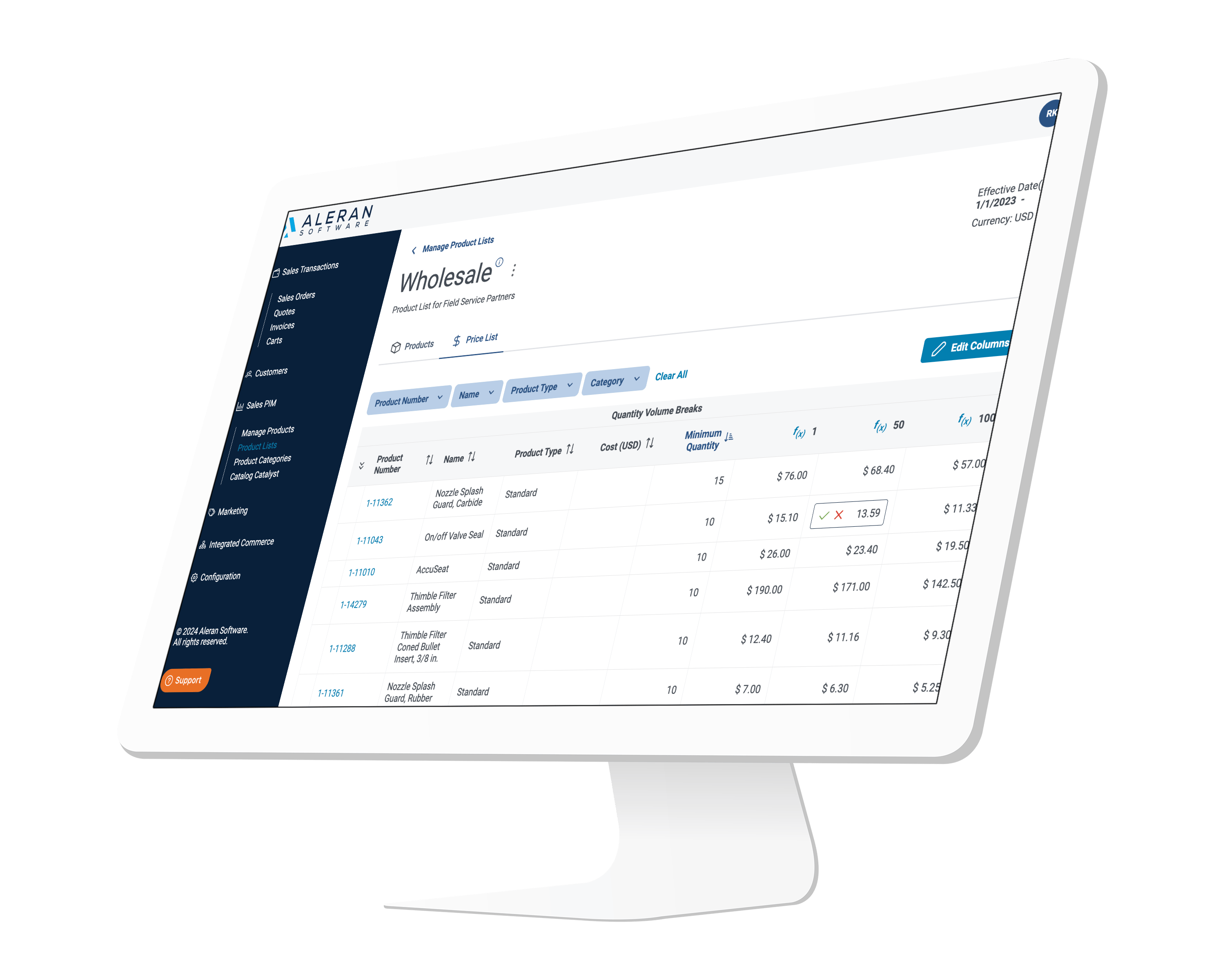
Pulls from the ERP, not a separate database. Pricing in manufacturing is rarely simple. Contract-specific pricing, volume tiers, dealer discounts, multi-currency — all of it lives in the ERP. A CPQ system that maintains its own pricing database creates a maintenance burden and a source of errors. The right architecture pulls pricing logic directly from the ERP in real time.
Is managed by business teams, not IT. When adding a new product, updating a pricing rule, or opening a new dealer channel requires an IT ticket, the system becomes a bottleneck. The best CPQ implementations for manufacturers are ones where product and sales operations teams can manage catalogs, rules, and configurations through a business-friendly interface without developer involvement.
Connects to the full customer journey. Quoting is one step. Customers want to track the status of their quote, convert it to an order, check fulfillment, and reorder — ideally from the same interface. CPQ that integrates with customer portals and eCommerce means that a dealer who receives a quote can accept and convert it without picking up the phone.
Deploys in weeks, not months. The faster a CPQ system goes live, the faster it starts protecting margins and winning deals. Platforms with pre-built ERP connectors and minimal configuration requirements are able to deploy in weeks because they don’t require starting from scratch on every implementation.
The “Over-Engineering” Trap
There’s a specific mistake manufacturers make when evaluating CPQ that’s worth naming directly: buying for the 20% case.
Every manufacturer has some products that are genuinely complex — engineer-to-order situations with deep CAD dependencies and manufacturing constraints that require engineering review before a quote can be finalized. That complexity is real, and it needs to be handled. But most manufacturers also have a large volume of products that are straightforward configure-to-order: the customer picks options from a defined set, pricing is calculable, and the quote can go out the same day with zero engineering involvement.
Traditional enterprise CPQ is often evaluated and purchased based on the 20% of products that need full engineering depth — and then applied to the other 80% where it’s massively over-built. The result is a system that handles the edge cases well and the everyday cases badly, with a user experience and maintenance overhead that reflects the most complex scenario rather than the most common one.
The right answer isn’t one platform for everything. It’s a CPQ architecture that handles the common case (sales-friendly, fast, self-service) as the default experience, with pathways to deeper engineering workflows for the cases that genuinely require them. Engineering CPQ tools like those built into Epicor, Infor, or similar platforms can handle the deep product logic; a sales-layer CPQ sits in front of that complexity and makes it accessible to reps, dealers, and distributors without requiring them to navigate engineering systems directly.
What “Simple” CPQ Actually Looks Like for Manufacturers
Simple doesn’t mean limited. It means right-sized for the job. For manufacturing sales, a well-designed CPQ platform:
Guides users through product configuration with visual selectors and guardrails that prevent incompatible options — without requiring the user to understand why certain combinations are invalid. It surfaces the right price for the right customer automatically, pulling account-specific pricing and discount logic from the ERP without manual lookup. It generates professional, branded quote documents immediately, with the ability to send, track, and follow up from the same platform. And it connects to a customer portal where the quote recipient can review, accept, and convert to an order on their own — without calling inside sales.
This is what sales-friendly CPQ looks like in practice: the underlying complexity is handled by the system, not the user. The rep or dealer sees a clean, guided experience. The back office sees accurate data flowing automatically into the ERP. And the customer sees a fast, professional response.
The Cost of Getting CPQ Wrong
The business case for getting CPQ right is clear — and so is the cost of getting it wrong.
Manual quoting consumes disproportionate sales team time. Research suggests that up to 66% of a sales rep’s time can be consumed by non-selling activities, including error correction and manual quote preparation. Every hour spent wrestling with a system that should be automating the process is an hour not spent on account growth, new prospect outreach, or strategic deal support.
Quoting errors create downstream costs that extend well beyond the sales team — incorrect configurations that go to production, pricing errors that require manual correction, orders that don’t match quotes. Each of these is a cost that a well-implemented CPQ system eliminates.
And the competitive risk is acute: in an environment where manufacturing demand is growing but margins are under pressure from rising input costs, the manufacturers who can quote faster and more accurately capture a disproportionate share of the business. The ones still running quotes through spreadsheets and siloed systems are leaving wins — and margin — on the table.
A Different Approach: CPQ Built for the Sales Layer
Aleran’s CPQ is designed from the premise that sales-layer CPQ and engineering-layer CPQ are different tools for different jobs — and manufacturers need both, but not from the same platform.
Where engineering CPQ handles deep product logic, BOM calculations, and manufacturing constraints, Aleran’s CPQ sits at the front of that complexity and makes it accessible to sales teams, dealers, and distributors through a guided, fast, intuitive experience. It integrates directly with ERP systems — Epicor, Infor SyteLine, SAP, Microsoft Dynamics, and others — pulling live pricing, inventory, and account data so that quotes are accurate from the moment they’re generated, without a separate pricing database to maintain.
The platform connects CPQ to the full customer journey: the same system that handles quoting also manages customer portals, eCommerce ordering, and order management — so the path from quote to order to fulfillment is seamless, with no manual handoffs and no system-switching. And because it’s built for business-team administration, new products, pricing rules, and channel configurations are managed by sales operations and product teams without IT involvement.
Typical Aleran deployments go live in weeks, not months — because the platform is built to configure, not to customize from scratch.
For manufacturers who have tried enterprise CPQ and found it too heavy, or who are still running quotes in spreadsheets because nothing else has fit, this is what a sales-appropriate CPQ approach looks like.
Ready to see what CPQ built for manufacturing sales — not engineering — looks like in practice? Schedule a demo →
Related Reading:
- What Is Manufacturing CPQ? And Why Do Manufacturers Need It?
- Already Have CPQ? Here’s What You’re Still Missing
- How to Integrate Epicor ERP with eCommerce Platforms
