


If you search “best B2B eCommerce platform for industrial manufacturers,” you’ll get a list of names you recognize. Shopify Plus. BigCommerce. Magento. OroCommerce. WooCommerce. And for simple B2B use cases — fixed pricing, standard catalog, straightforward checkout — several of those platforms can sometimes work fine.
But industrial manufacturers don’t have simple B2B use cases.
They have customer-specific pricing and contract tiers. Configurable products where a wrong selection creates a quoting error or a fulfillment problem downstream. Complex freight rules, multi-warehouse logic, and sales reps who need account visibility without logging into the ERP every time. They have Infor, Epicor, or another ERP running their operations — and any eCommerce platform that can’t connect to it deeply is creating a gap, not closing one. As a result, ERP-integrated B2B eCommerce is a must-have.
To make this concrete: I’m currently working with exactly this type of manufacturer. A CTO who inherited a legacy eCommerce platform with limited Infor SyteLine integration — one that can’t handle the complex pricing, workflows, and system connections needed to run the business efficiently, let alone grow it. He’s close to submitting a 100-plus requirement RFP to replatform. His words when he started the process: “We have to get this right.”
The numbers behind that urgency are real. Today, nine percent of their revenue flows through eCommerce. With the right platform — one that lets the sales and service teams process all orders, not just the ones that fit the current system’s limitations — that number could grow to represent two-thirds of total sales. Average Order Value today sits at $4,000. With proper product configuration capability built in, we project a minimum 18% increase.
The platform choice is the difference between those numbers staying theoretical and becoming real.
That’s why the best B2B eCommerce platform for an industrial manufacturer isn’t the most popular platform. It’s the one actually built for your environment. This post breaks down what that means — and what to look for when you evaluate.
Why Generic Platforms Fall Short for Industrial Manufacturers
Most B2B eCommerce platforms were designed for distributors with large, relatively static catalogs and consistent pricing. Add a product, set a price, display it online, take an order. That works for a lot of businesses.
It does not work for industrial manufacturers whose products have configuration options, whose customers have negotiated contracts, and whose orders need to route through an ERP, trigger warehouse assignment logic, and generate accurate freight costs at checkout — not as an afterthought.
When manufacturers try to force generic platforms to handle this complexity, one of two things happens: either the platform can’t do it natively and someone builds expensive custom integrations to paper over the gaps, or the platform technically supports it but requires months of development before a single order is placed.
Both outcomes are slow, expensive, and delay the ROI that justified the investment in the first place.
The right answer is a platform purpose-built for manufacturers — one where the complexity you deal with every day is the baseline, not a special case.
What Industrial Manufacturers Should Actually Look For
Here is a practical framework for evaluating B2B eCommerce platforms as an industrial manufacturer. These are not nice-to-haves. They are table stakes.
1. Native ERP Integration — Bidirectional, Not One-Way
Your ERP — whether that’s Infor CloudSuite Industrial (SyteLine), Epicor Kinetic, or another platform — is your system of record. Pricing lives there. Customer contracts live there. Inventory and order history live there.
Any eCommerce platform that requires you to duplicate that data, manually sync it, or maintain a shadow system is creating more work, not less. What you need is a platform that connects bidirectionally with your ERP out of the box: pulling pricing, catalog, and customer data into the commerce layer, and writing orders and activity back — without manual intervention.
For manufacturers running on Infor and Epicor and other ERPs specifically, this integration needs to be detailed. Ask how warehouse assignment is handled at the order line level. Ask what happens when a customer-specific price changes in the ERP — how quickly does the commerce layer reflect it?
2. Complex B2B Pricing Support
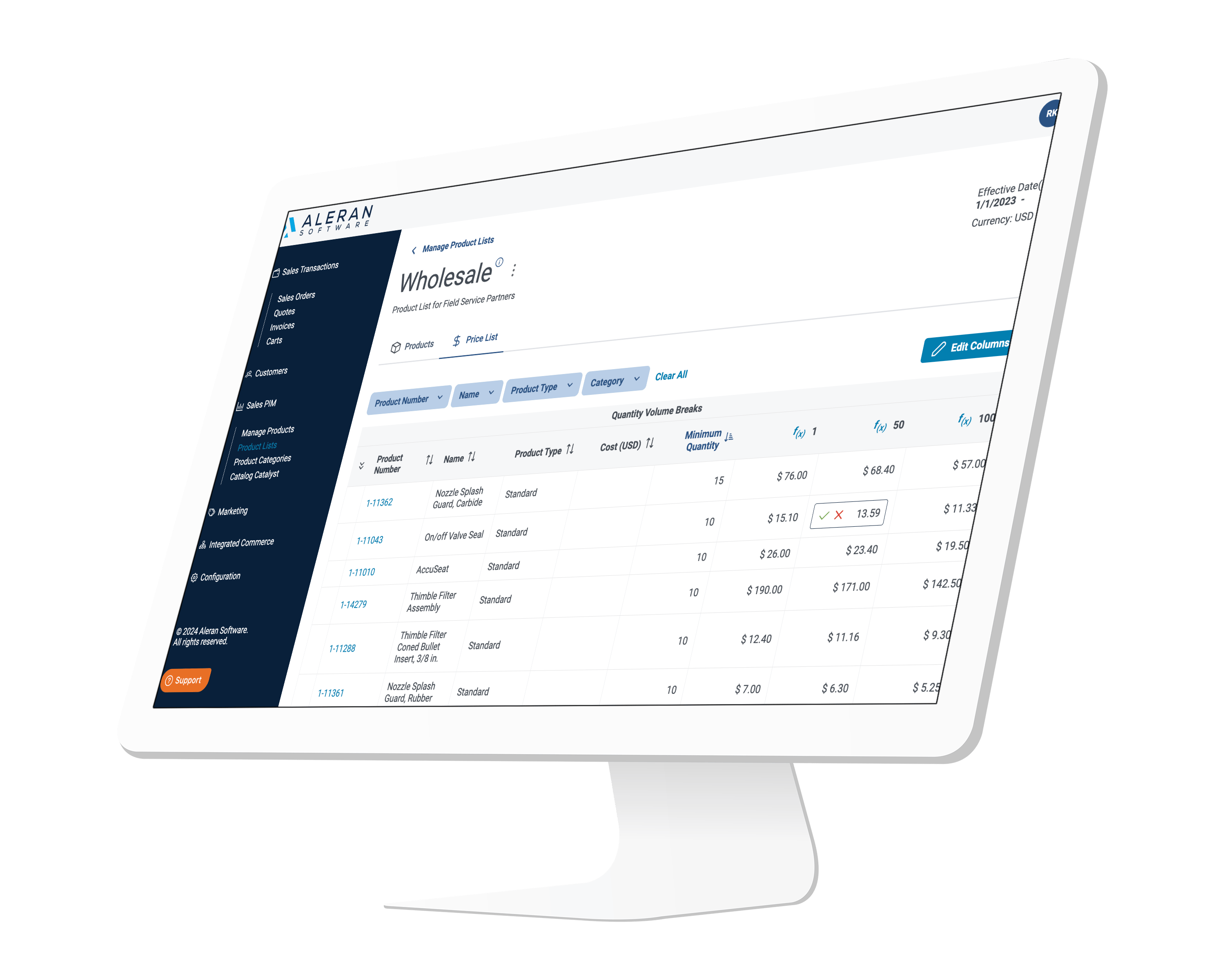
B2B pricing for industrial manufacturers is not a price tag. It is a set of rules — customer-specific tiers, contract pricing, volume breaks, discount guardrails by sales role, promotional pricing with expiration dates. Every customer may see a different price for the same product.
Generic platforms handle this poorly or require significant custom development. Purpose-built manufacturing platforms handle it natively. The difference shows up in quoting accuracy, sales rep confidence, and AR reconciliation time.
3. CPQ and Sales Configurator — Built In, Not Bolted On
Industrial manufacturers with configurable products face a choice that most platform evaluations overlook: do you buy a separate CPQ tool, integrate it, maintain it, and pay for it separately — or do you choose a platform with CPQ-lite / sales configurator capability built in?
The case for built-in is strong. A native sales configurator means no separate implementation, no integration to maintain, and no additional vendor to manage. Your sales reps and customers get a guided configuration experience that applies your product rules and pricing logic in real time — generating accurate quotes in minutes, not days — all within the same platform where orders are placed and managed.
This is the difference between a platform you assemble from parts and a platform that works as a system.
(For a deeper look at when to use a sales configurator versus engineering CPQ, see our post on Sales CPQ vs CAD Configurators: When Manufacturers Actually Need Each)
4. A Customer Portal That Actually Serves B2B Buyers
Your customers are not consumers. They are purchasing managers, plant supervisors, and procurement teams who need to reorder efficiently, check order status, review invoices, and access their account information — at 10pm on a Tuesday if that’s when they’re working.
A B2B customer portal for manufacturers should support: customer-specific catalogs, one-click reorder from order history, shopping lists and favorites for frequently purchased items, real-time order and shipment status, and self-service account management. The Infor Customer Portal and Epicor Commerce Connect (ECC) provide some of this — but manufacturers consistently report limitations that a purpose-built commerce platform overcomes.
5. A Native Sales Console That Reduces ERP Dependency
One of the most underappreciated costs in manufacturing sales organizations is ERP licenses for sales reps who only need a fraction of the ERP’s functionality. They need to see customer accounts. Check order status. Review pricing. Create quotes. That does not require full ERP access — it requires a well-designed sales console.
A purpose-built manufacturing eCommerce platform should give your sales team everything they need day to day without logging into the ERP:
- All orders regardless of source (eCommerce, phone, EDI)
- Current and on-order balances, pending orders, and order history
- Frequently ordered items and customer-specific shopping lists
- Abandoned cart visibility so reps can follow up and recover lost revenue
- Pricing visibility including customer-specific and contract pricing
- Account activity relevant to sales — orders, quotes, account status
When your platform provides this natively, you can eliminate ERP licenses for many sales users — a meaningful cost reduction that contributes directly to platform ROI.
A practical approach: map each sales role to the information and workflows they actually require. If the sales console covers those needs, ERP access for that role becomes optional, not mandatory.
6. AI That Works for Manufacturers — Not Generic Product Recommendations
AI in B2B eCommerce for manufacturers is not about showing “customers who bought this also bought that.” It is about surfacing the right product for a complex buyer who knows what they need but may not know your catalog well enough to find it quickly.
The right AI capability for industrial manufacturers includes: predictive search trained on your product data, an AI shopping assistant that can answer technical product questions from your ERP-connected catalog, and intelligent reorder suggestions based on that customer’s actual purchase history. This reduces friction for buyers, reduces inbound support calls, and increases average order value — without adding headcount.
The important distinction: AI built on generic training data is not the same as AI trained on your ERP-connected product and customer data. The former gives generic answers. The latter gives accurate ones.
7. CRM and Systems Connectivity
Your B2B eCommerce platform will not operate in isolation. It needs to connect to your ERP, your tax platform (Avalara), your payment gateway, your freight and shipping tools, and — for many manufacturers — a CRM.
Platforms built on open APIs make these connections manageable. Platforms with proprietary, closed architectures make every integration a project.
For manufacturers evaluating whether their eCommerce platform can reduce the need for a separate CRM: a strong native sales console handles the order and account visibility side of sales work. For deeper CRM functionality — call logging, pipeline management, opportunity tracking — the right answer is a platform that integrates openly with the CRM of your choice, rather than one that promises to replace it and falls short.
Speed, Affordability, and ROI: Why Implementation Timeline Matters More Than You Think
Every month you spend implementing an eCommerce platform is a month you are not generating return on that investment. For industrial manufacturers, a slow implementation has a compounding cost: continued inefficiency, continued lost orders, continued reps spending time on tasks a platform should automate.
The right platform — one that’s purpose-built for your environment and natively handles your ERP integration — should be live in 90 days or less. That is not an unrealistic expectation. It is a reasonable benchmark for a manufacturer whose product data, pricing, and customer records already exist in the ERP. The heavy lifting is largely done.
Affordability matters too. Platforms priced on per-user or per-transaction models penalize exactly the broad adoption you need to drive ROI. A platform priced by platform — not by seats or volume — means your buyers, reps, ops team, and administrators are all included at a predictable cost that doesn’t scale against you as usage grows.
The math on speed and cost is straightforward: a platform that costs less, goes live faster, and doesn’t charge more as you grow generates ROI faster. That is not a secondary consideration. For most manufacturers, it is the decision.
The All-in-One Advantage: Why Piecemeal Doesn’t Work for Manufacturers
The traditional approach to manufacturing eCommerce looks like this: buy an eCommerce platform, buy a separate CPQ tool, buy a customer portal, buy a sales enablement layer, integrate them all, and maintain those integrations as each vendor updates their product independently.
Every integration is a point of failure. Every vendor contract is a renewal. Every update is a compatibility risk.
The alternative is a platform where eCommerce, CPQ and sales configurator, customer portal, sales console, AI, and ERP integration are native to a single system. Not integrated after the fact — built to work together from the start.
This is what purpose-built means for industrial manufacturers. Not a collection of tools that can be made to work together. A system that works together by design, with one implementation, one vendor relationship, and one roadmap that reflects the needs of manufacturers — not retail.
The Bottom Line: “Built for B2B” Is Not the Same as “Built for Industrial Manufacturers”
Many platforms claim to serve B2B manufacturers. Fewer of them are actually built for the level of complexity that industrial manufacturing requires: configurable products, customer-specific pricing, ERP-connected workflows, complex freight logic, and a sales team that needs full account visibility without full ERP access.
The question to ask every platform in your evaluation is not “can you handle this?” — any vendor will say yes. The question is: “does your platform handle this natively, out of the box, without custom development?” The answer to that question separates platforms built for manufacturers from platforms that have been stretched to accommodate them.
When you find one that answers yes — to ERP integration, complex pricing, native CPQ, a real sales console, AI trained on your data, and an implementation timeline measured in weeks — that is the platform worth your investment.
Ready to see what CPQ built for manufacturing sales — not engineering — looks like in practice? Schedule a demo
Related Reading:
- What Is Manufacturing CPQ? And Why Do Manufacturers Need It?
- Manufacturing is Growing Again – But Cost Pressures Are Eating Your Margins. How ERP-Connected Portals Can Help.
- Your ERP Isn’t Broken – Your Sales Process Is: The Case for Digital Quoting & Selling In Manufacturing
