



I just returned from Smart Manufacturing Week UK (where Aleran exhibited, and I had the opportunity to present as well). I met a wide variety of manufacturing leaders — in sales, operations, IT, and executive leadership, and interestingly they shared a common concern: quoting.
I know they had other concerns across their organizations, from supply chain to manufacturing to inventory and fulfillment, yet something as simple as effective quoting was still a top-of-mind concern for many of them.
From those conversations – and our own “Built to Sell” research – it’s clear that for so many manufacturers, quoting processes remain stuck in past: done based on gut feel, job sheets, a spreadsheet that someone built years ago, or a sales rep or two who knows the product well enough to wing it.
Whether it’s because they’re using the wrong tools, or because they’ve just always done things a certain way, the net result is the same: less-than-optimal quoting is costing manufacturers real money.
Quoting Has Layers — And Most Manufacturers Are Only Solving One
Most manufacturing organizations hear the word “quoting” and immediately think one of two things: engineering CPQ for complex, made-to-order products, or the manual process their team has always used. The problem is that the vast majority of manufacturing quoting challenges aren’t engineering problems — they’re sales workflow problems. And they need a different solution.
At the top of the stack, yes, there is engineering CPQ — CAD-integrated, rules-based configuration tools designed for highly engineered products. Tools like Tacton, Epicor CPQ, and Infor CPQ are powerful in the right context. If your product genuinely cannot be quoted without engineering sign-off, you likely need engineering CPQ.
But here’s what I regularly see in the field: the majority of manufacturing sales teams don’t have that problem. Their products have options, variants, pricing tiers, customer-specific contracts, discount rules, and lead times that vary by configuration. And every one of those variables is currently living in someone’s head, in a spreadsheet, or locked inside the ERP where a sales rep can’t get to it quickly.
That is not an engineering problem. That is a sales workflow problem — and it deserves a different solution.
What Is a Sales Configurator — And How Is It Different from Engineering CPQ?
A sales configurator is a lightweight CPQ tool designed specifically for the sales layer, not the engineering layer. Where engineering CPQ tools require deep technical configuration and potentially months of implementation, a sales configurator reflects your existing product and pricing logic in a system that sales reps — and customers — can actually use.
Here is what it does well:
- It speeds up the quoting process without engineering involvement
Instead of a rep building a quote manually from job sheets and tribal knowledge, a guided selection process walks them — or the customer — through the available options. The system applies the right pricing rules, checks for incompatible combinations, and generates an accurate quote in minutes instead of days.
- It improves accuracy without adding complexity
Quoting errors in manufacturing are expensive. A sales configurator enforces the rules your team already knows but doesn’t consistently apply. It doesn’t require a 12-month implementation — it reflects your existing product and pricing logic in a system that executes it reliably every time.
- It creates a better customer experience
B2B buyers are also consumers, and they bring those same expectations to work: they expect simplicity, and they want answers quickly. A sales configurator embedded in a B2B commerce platform lets customers self-serve through configuration and quoting, get a real number, and move toward a decision faster. Manufacturers unable to meet those expectations are losing business and leaving money on the table.
- It ties back to your ERP and automates downstream workflows
This is where the CPQ-lite approach pays dividends that most manufacturers don’t anticipate. When quoting happens in a disconnected spreadsheet, the data dies there. A properly integrated sales configurator pushes quote data back to Infor SyteLine, Epicor Kinetic, or your system of record. It can trigger automated follow-up reminders, initiate a campaign if a quote goes cold, and notify a rep when a customer revisits a quote they haven’t acted on. The quote becomes the beginning of a workflow — not a dead-end document.
Why Choosing the Right Tool Matters
Engineering CPQ tools are built for engineering teams. They require significant IT involvement, months of configuration, and heavy change management. When a mid-market manufacturer applies that solution to a sales workflow problem that doesn’t require it, getting the desired return on investment may well be impossible.
The answer isn’t to abandon CPQ. It’s to match the tool to the problem:
– Complex, engineered-to-order products → Engineering CPQ (Tacton, Infor CPQ, Epicor CPQ)
– Products with defined options, rules, and customer-specific pricing → Sales configurator / CPQ lite
For the many manufacturing catalogs that follow predictable rules, a lightweight sales configurator is faster to implement, easier to adopt, and more directly connected to the revenue outcomes your sales team actually cares about.
What This Means for Manufacturers running Infor and Epicor (or any ERP)
For manufacturers running Infor CloudSuite Industrial (SyteLine) or Epicor Kinetic, there’s a gap between back office capability and customer experience: the ERP has all the data — pricing, customer contracts, inventory, lead times, product rules; but it was not designed to be a customer-facing or sales-facing quoting tool.
The result: sales reps do manual workarounds, or customers wait while someone translates ERP data into a quote by hand.
A sales configurator integrated with Infor SyteLine or Epicor Kinetic solves this without displacing the ERP. The ERP stays the system of record; the configurator pulls pricing and product rules from it, applies them in the sales layer, generates accurate quotes, and writes the output back. No duplicate data entry. No spreadsheet in between. And the implementation timeline is measured in weeks — not the quarters typically associated with full engineering CPQ deployments.
The Question I’d Ask Every Manufacturing Sales Leader
If quoting is a bottleneck for your team — slow turnaround, inconsistent pricing, customer frustration, or reps spending more time building quotes than selling — ask yourself one question before you go looking at engineering CPQ tools:
Is this a complexity problem, or is this a process and access problem?
If your product requires engineering sign-off to configure, you may need engineering CPQ. But if your product has a defined set of options and rules that a rep or a customer could navigate with the right guidance, you need a sales configurator — something lighter, faster to implement, connected to your ERP, and designed for the people who sell, not the people who engineer solutions.
The technology exists. The ERP integrations are proven. And the question is simply whether you’re ready to stop solving a sales problem with an engineering tool.
Ready to see how Aleran’s sales configurator works alongside your existing ERP? Let’s Book Time to Talk
Commonly Asked Sales CPQ vs Engineering CPQ Questions
1. What is the difference between Sales CPQ and Engineering CPQ?
Sales CPQ (Configure, Price, Quote) is software designed to help sales teams quickly build accurate quotes for configurable products. It focuses on commercial outcomes — selecting valid product combinations, applying pricing rules, and generating a professional quote document — without requiring engineering input.
Engineering CPQ (also called a product configurator or engineering configurator) goes further by generating technical outputs alongside the quote. When a sales rep configures a product, an engineering CPQ simultaneously produces BOMs (bills of materials), routings, CAD drawings, and other manufacturing artifacts needed to actually build it.
The core distinction: sales CPQ speeds up the quoting process; engineering CPQ automates the handoff from quote to production. For manufacturers selling complex, custom products — industrial equipment, configured machinery, specialty fabrications — a pure sales CPQ can produce accurate pricing but still leave engineering teams manually translating that quote into production-ready documents. Engineering CPQ closes that gap.
Most manufacturers need to evaluate sales CPQ vs engineering CPQ based on where their bottleneck actually lives: in the quoting step, or in the quote-to-production handoff.
Blog post: Sales CPQ vs CAD Configurators for Manufacturing
- What does a Sales configurator do?
A sales configurator is the product selection engine inside a sales CPQ. It guides a sales rep (or a customer in a self-service scenario) through a structured set of choices — features, options, components — and enforces rules that prevent invalid combinations from ever being selected.
Specifically, a sales configurator:
- Presents valid options only — compatibility rules hide or disable selections that would create an unbuildable or unsellable product
- Calculates price in real time — as options are added, the configurator applies pricing logic, discounting rules, and margin thresholds automatically
- Generates a quote document — once configuration is complete, it produces a formatted proposal ready for customer delivery
- Feeds downstream systems — it passes the configured order to ERP, CRM, or production systems without re-keying
For manufacturers comparing sales CPQ vs engineering CPQ, the sales configurator handles the commercial layer. An engineering configurator adds a technical layer on top, producing BOM and routing outputs in parallel with the quote.
Aleran Connected Commerce CPQ for Manufacturing Feature In Detail
- Do manufacturers need engineering configurators or CPQ?
Most manufacturers need both — but the right starting point depends on where inefficiency is causing the most pain.
Start with sales CPQ if:
- Quoting takes too long and sales reps rely on engineers to price deals
- Quotes frequently contain errors because configuration is done manually in spreadsheets
- You need faster response times to win more competitive bids
- Your products have many options but follow predictable commercial rules
Add or prioritize engineering CPQ if:
- Engineering spends significant time translating approved quotes into BOMs, drawings, or work orders
- Every order is custom enough that production documents must be generated per quote
- You manufacture to order and need tighter integration between sales configuration and shop floor execution
In the sales CPQ vs engineering CPQ decision, manufacturers with high-mix, low-volume production (custom machinery, configured industrial equipment, specialty fabrication) typically need both layers working together. Manufacturers with more standardized products often find that sales CPQ alone dramatically reduces quoting time and error rates.
Blog Post: Why Most CPQ Is Too Complex for Manufacturing Sales
- Why do CPQ implementations fail in manufacturing?
CPQ implementations in manufacturing fail most often for four reasons:
- Product rules are too complex for a generic CPQ. Off-the-shelf sales CPQ tools are designed for software, technology, or commercial products. When applied to engineered-to-order manufacturing — where hundreds of interdependent options interact — the configuration logic becomesunmanageableand the tool breaks down.
- The CPQdoesn’tconnect to ERP. A quote is only useful if it translates into production. When CPQ and ERP (Infor, Epicor, SAP, etc.) don’t share data, manufacturers end up with two parallel systems and manual re-entry between them — eliminating much of the time savings CPQ was supposed to deliver.
- Implementation is treated as an IT project, not aprocessredesign. CPQ requires clean, structured product and pricing data. Manufacturers that feed disorganized product catalogs and inconsistent pricing into a CPQ implementation get inaccurate quotes at high speed — which is worse than slow accurate quotes.
- Choosing sales CPQ when engineering CPQ is needed. For highly custom manufacturers, deploying a sales CPQ without addressing the engineering handoff creates a new bottleneck: quotes go out faster, but engineering is still overwhelmed translating them into production documents.
Understanding the sales CPQ vs engineering CPQ distinction before selecting a platform is one of the most important steps in avoiding implementation failure.
Resource Guide: Best B2B Commerce For Manufacturing: 5 Criteria That Actually Matter
- How to automate quoting in manufacturing?
Automating quoting in manufacturing requires three connected capabilities working together:
Step 1 — Structured product configuration. Replace manual spec sheets and spreadsheets with a rules-based configurator that enforces valid combinations and drives pricing automatically. This is the core of any sales CPQ.
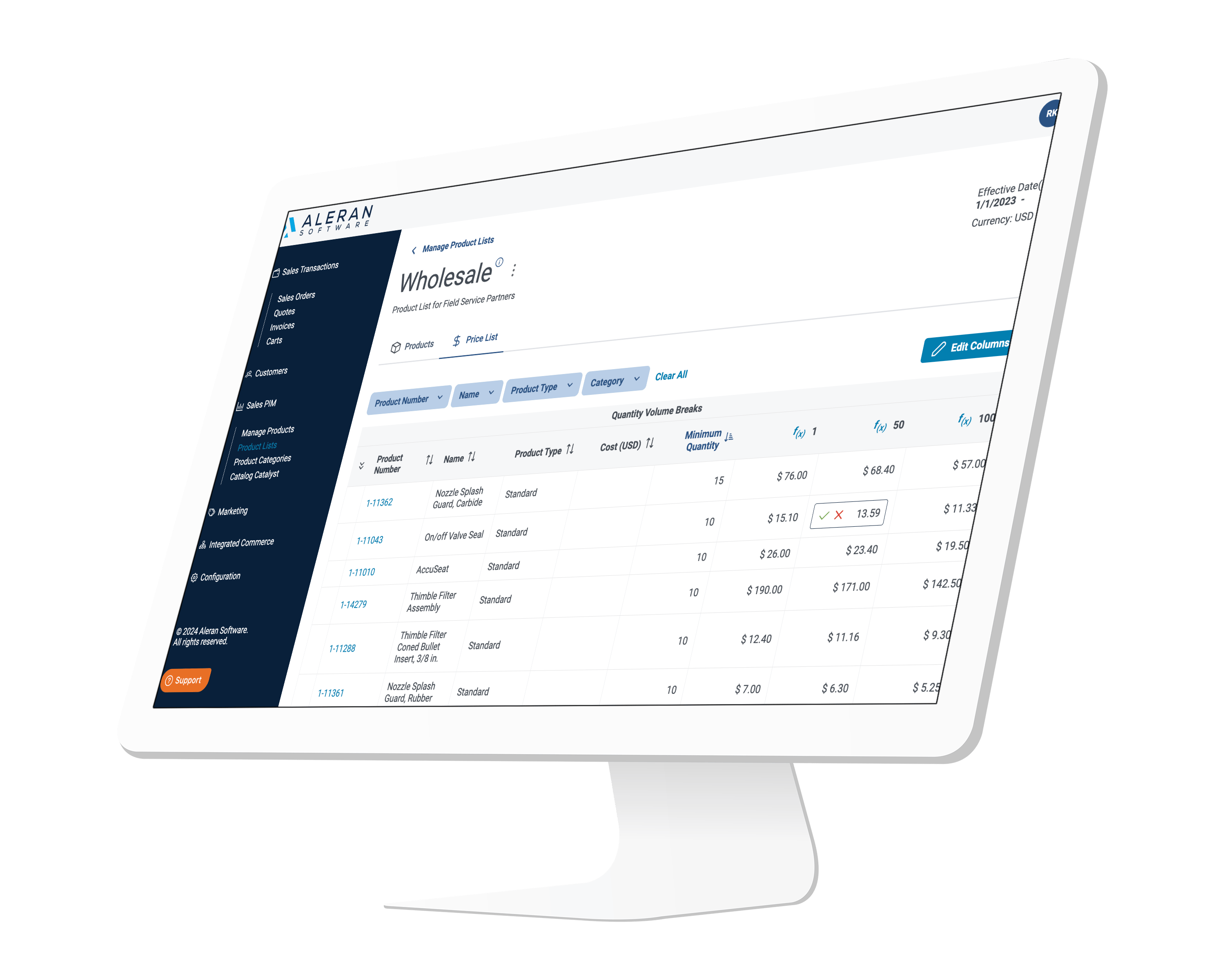
Step 2 — Automated pricing logic. Pricing rules — volume breaks, customer-specific discounts, cost-plus margins, option surcharges — should be encoded in the CPQ, not held in a salesperson’s head or a spreadsheet. When configuration drives price automatically, the quote is accurate the moment configuration is complete.
Step 3 — ERP integration. For manufacturers, a quote becomes an order — and that order needs to flow directly into ERP (Epicor, Infor, SAP, etc.) without re-entry. Integrating CPQ with ERP automates the handoff from approved quote to production planning.
For manufacturers selling engineered-to-order products, full quoting automation also means connecting to engineering CPQ outputs — so that when a quote is approved, the BOM and routing are already generated and waiting. The sales CPQ vs engineering CPQ question matters here: a sales-only approach automates the commercial side but leaves the production translation manual.
Integrations Guide: Aleran Connected Commerce Integrations 101
Ready to see what CPQ built for manufacturing sales — not engineering — looks like in practice? Schedule a demo
Related Reading:
- What Is Manufacturing CPQ? And Why Do Manufacturers Need It?
- Manufacturing is Growing Again – But Cost Pressures Are Eating Your Margins. How ERP-Connected Portals Can Help.
- Your ERP Isn’t Broken – Your Sales Process Is: The Case for Digital Quoting & Selling In Manufacturing
